

Which Traders Use Direct Market Access?
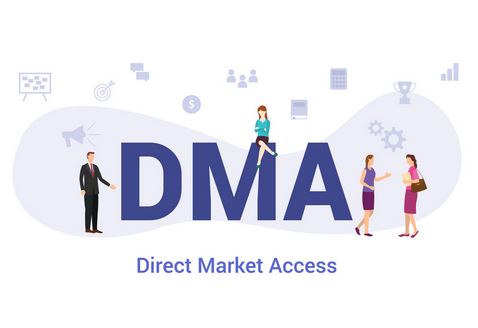
Direct market access (DMA) refers to an electronic trading method in which investors can trade directly with electronic order books.
The seller is responsible for matching the price that a buyer wants to pay for security with the price that the buyer wants to pay for the security until the order matches.
Brokers and financial institutions are typically the only ones to place orders in the order book. Traditionally, investors would call or email their brokers to place a trade. An investor would then be able to find the best price through the broker.

Trading directly on Foreign exchange is possible via direct market access, bypassing brokers. Therefore, the price of the orders is up to the trader.
All Foreign exchanges and securities traded on the Foreign exchange can benefit from direct market access. Thus, investors can invest in equities, fixed-income securities, financial derivatives, or other financial instruments.
How are trades executed in Direct Market Access?
An online trading platform allows a trader to purchase securities. Information reaches exchange servers once the order has appeared in a trading book. Upon receiving an order from the trader, the stock exchange can fulfill it once a seller’s price matches the trader’s.
Who uses Direct Market Access?
Only advanced traders should gain direct market access since it may be difficult. For example, the option of algorithmic trading allows experienced traders to use advanced trading strategies.
Furthermore, because of the requirements to execute orders in high volumes, the system is also suitable for investors who plan on placing large volumes of transactions.
The buy-side, including hedge funds, mutual funds, pension funds, and private equity funds, is also a user group. Investment banks can provide direct market access to buy-side firms by using their technology infrastructure. Direct market access services are offered by many sell-side firms now.

Advantages of Direct Market Access
- By eliminating brokers, investors can access the market faster and reduce transaction costs, increasing the transaction speed.
- Investors manage transactions rather than brokers, so they have more control over trade orders.
- Participating in premarket and postmarket auctions is an option for the investor.
- Investing takes place anonymously, and no third-party vendors are involved, so there is no risk of leaking investors’ confidential information. When trade, direct market access providers use their identities, not investors.
- With high-frequency trading, investors can participate in algorithmic trading that utilizes high-frequency data and trading tools to produce high speeds and high turnover rates.
Disadvantages of Direct Market Access
- Accessing Foreign exchanges and enabling electronic trading requires sophisticated technology infrastructure. Maintenance can therefore be expensive for businesses.
- The connection to direct market access may be affected if there are issues with internet connectivity. To ensure proper operation, regular system maintenance must be performed.
- To ensure the proper execution of trades, it is heavily regulated.
- The result will be less flexibility in trading compared with over-the-counter trading.
Inactive accounts or infrequent trading will incur penalty fees if the account becomes inactive.
CFDs are complex instruments and carry a high risk of rapid losses due to margin trading. Consider whether you understand how CFDs work and whether you can afford the risk of losing your money. This article is for educational purposes and is not investment advice.
Author: Andrew Trent
Andrew holds a degree in Data and Statistical Analysis and brings a tech nerd's curiosity to his writing. Off the clock, he's modeling data scenarios for fun, scuba diving, or taking underwater photos. He lives with his two Labradors, Homer and Duff, and his cat, Fibonacci.
Reviewed by: Chris Blakely
Content Editor with over two decades in financial journalism and a degree in Computer Engineering from the Polytechnic of the South Bank. Chris checks every article for factual accuracy and verifies claims before publication.
Last updated: December 9, 2022
Related Reading
Trader Sentiment
Share your outlook and see the results.
Bullish or bearish on EURUSD today?
Bullish or bearish on Bitcoin today?
Trending topics
FOREX HEATMAP
