

Ways to Trade Currency Strength Meters for Forex
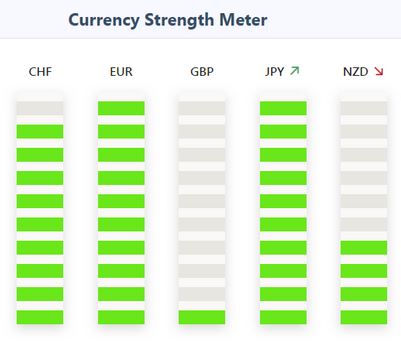
A Forex Strength Meter is a technical indicator that uses algorithmic data to help traders gauge the strength of individual currencies. Currency Strength Meter can also be found on the web if you use MT4, MT5, or any other platform that supports custom indicators.
This guide explains how the strength meter works, how to download it, and how it can be used in a volatile market such as Forex.

How does the currency strength meter work?
To understand how the currency strength meter (CSM) works, let’s look at what a currency strength meter is in the context of Forex trading. In contrast to external software, the CSM currency strength meter analyzes and predicts future market prices as a technical indicator. However, it can also serve as both, as stated earlier.
There are several ways to measure the strength of a currency, including downloading apps, using algorithms, or integrating the indicator into your trading platform. Trading can be more informed if traders can determine the strength of currency prices.
For instance, the currency strength indicator MT4 can be opened via the MetaTrader 4 platform. The steps in the process are as follows:
- Calculate the base currency
- All available currencies for a given currency
- Calculate each currency’s strength relative to the other
- Average the scores
Essentially, the Forex strength meter is used as a “filter”. By understanding why a pair moved, you can make better trading decisions. The strength meter of a particular currency will always be determined by the timeframes set for it, which is another crucial factor to consider.
If you open the indicator for the 5-minute timeframe, the strength of the USD may be very low, while the strength may be very high in the daily timeframe. With Forex meters, traders can improve their prediction accuracy.
The trending currency may be wise to avoid placing orders against it, for example, if it is making sharp moves and trending, while the ranged currency is ranging. Furthermore, Forex meters help fundamental traders spot active currencies and analyze their behaviours.

How to measure the strength?
CSM indicators are usually rated between 0-10, with a higher rating considered stronger. The closer the number is to 10, the stronger the currency. It is important to note that this number can also be below 1.
Also, position traders, swing traders, and intraday traders use currency strength meters daily, while intraday traders use currency strength meters that are life.
Mistakes to avoid when using CSM
Using CSM only on its own is most beginners’ biggest mistake when trading. It would help to pair your trading with additional trading tools for this indicator to be effective. A Forex meter shows only the currencies active in a specific currency pair and those dull in a specified timeframe.
A second mistake is calculating a currency’s strength relative to major currencies. For example, the USD must be strong against the EUR, GBP, CHF, and JPY for it to be strong.
A major world reserve currency is the Euro, and the EUR/USD pair is the most traded. Currency pair performance significantly impacts other pairs with these currencies, either as base or quote currencies.
As a final mistake, using only short timeframes is not advisable if the Forex strength meter is to be used for trading.
Bottom line
Currency strength meters measure the strength of currencies against a basket of major currencies and are usually the first tool traders use when analyzing a currency pair. In position traders, currency strength meters are used daily, while in intraday traders, currency strength meters are used on a live basis.
When using the CSM’s data, you should always look at the market’s current situation. The CSM’s data will only be useful if it is recovering from a spike. CSMs help traders avoid trading against currencies that are strongly trending.
It is easy to disrupt the CSM when there is a major event in the market that brings massive change to the market. We see spikes and plunges all the time.
CFDs are complex instruments and carry a high risk of rapid losses due to margin trading. Consider whether you understand how CFDs work and whether you can afford the risk of losing your money. This article is for educational purposes and is not investment advice.
Author: Andrew Trent
Andrew holds a degree in Data and Statistical Analysis and brings a tech nerd's curiosity to his writing. Off the clock, he's modeling data scenarios for fun, scuba diving, or taking underwater photos. He lives with his two Labradors, Homer and Duff, and his cat, Fibonacci.
Reviewed by: Chris Blakely
Content Editor with over two decades in financial journalism and a degree in Computer Engineering from the Polytechnic of the South Bank. Chris checks every article for factual accuracy and verifies claims before publication.
Last updated: January 24, 2023
Related Reading

Trader Sentiment
Share your outlook and see the results.
Bullish or bearish on EURUSD today?
Bullish or bearish on Bitcoin today?
Trending topics
FOREX HEATMAP
