

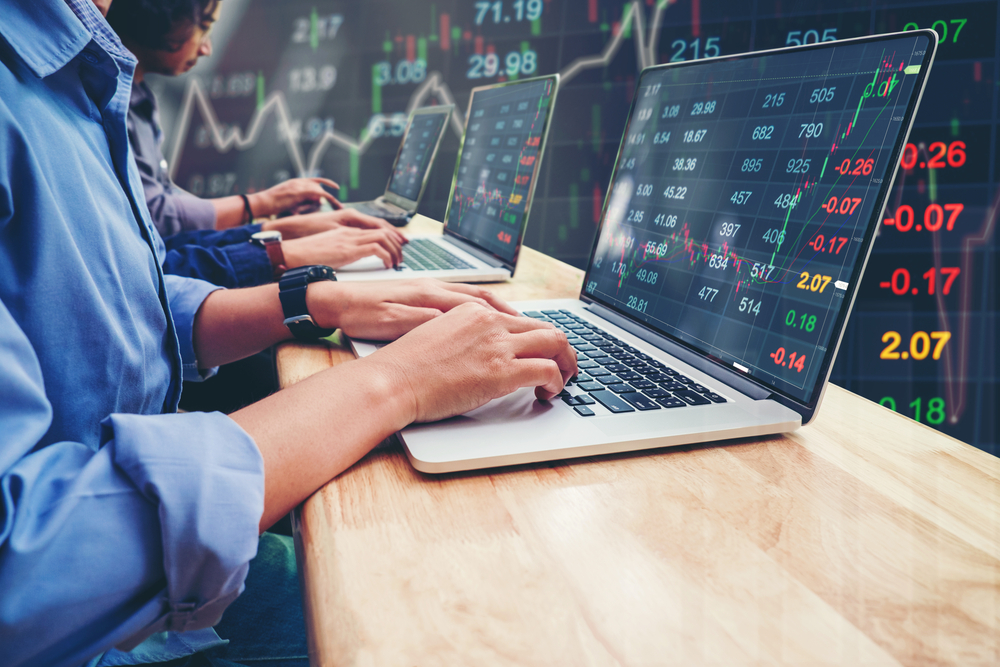
Trading Platforms: Algorithmic Trading as a Means of High-Frequency Trading
There’s this kind of algorithmic trading that features trading in the foreign exchange market with high order-trade ratios and high turnover rates; it’s done rather fast, too. It’s called HFT or high-frequency trading.
Since it covers various subjects with regard to algorithmic trading, HFT trading comes with nary a single definition. And, while it’s a celebrated trading approach to some traders, it signals alarm to others; it has its own share of controversial aspects.
Here’s a compilation of facts:
- – In the early years, around the late 90s, HFT accounted for not more than 10% of the total trading volume. Five years later, it grew to over 160% of the trading volume in the forex market. And, as reported by the NYSE (or New York Stock Exchange), it regularly raked in over $120 billion.
- – HFT began in the late 90s; the date can be traced back to the time when electronic exchanges were first authorized by the Securities and Exchange Commission of the US. Initially, several seconds is the allotted execution time. Almost a decade later, in 2010, the significant decrease of execution time marked a grand development; currently, the execution time is down to a millisecond.
- – HFT adheres to the significance of statistics and arbitrage. It works around the concept of forecasting temporary deviations in market elements; for the deviations to be determined, it can involve a closer inspection of the properties in market elements.
- – The practice called tick processing or ticker tape reading is often associated to HFT. It goes in line with the logic that the origins of trading data should be recognizable; since they signify relevance, processing all the information that is contained in the trading data can be very useful.
- – A traditional HFT technique is referred to as filter trading; the outstanding factor is that filter trading may be accomplished at a relatively slow pace. Like any HFT technique, it is about the analysis of bulks of data; it includes interpreting the information based on press releases, news, and other forms of announcements. Once the interpretation is done, the analyst inputs data in software programs.
- – HFT is categorized as quantitative trading; unlike qualitative trading, the end goal is to gain an accumulated sum from small positions. Behind it, the concept lies in the fact that there is profitability in simultaneously processing algos (i.e. large volumes of market information) – an activity that human traders are unable to handle.
CFDs are complex instruments and carry a high risk of rapid losses due to margin trading. Consider whether you understand how CFDs work and whether you can afford the risk of losing your money. This article is for educational purposes and is not investment advice.
Author: Andrew Trent
Andrew holds a degree in Data and Statistical Analysis and brings a tech nerd's curiosity to his writing. Off the clock, he's modeling data scenarios for fun, scuba diving, or taking underwater photos. He lives with his two Labradors, Homer and Duff, and his cat, Fibonacci.
Reviewed by: Chris Blakely
Content Editor with over two decades in financial journalism and a degree in Computer Engineering from the Polytechnic of the South Bank. Chris checks every article for factual accuracy and verifies claims before publication.
Last updated: April 29, 2021
Related Reading
Trader Sentiment
Share your outlook and see the results.
Bullish or bearish on EURUSD today?
Bullish or bearish on Bitcoin today?
Trending topics
FOREX HEATMAP
