

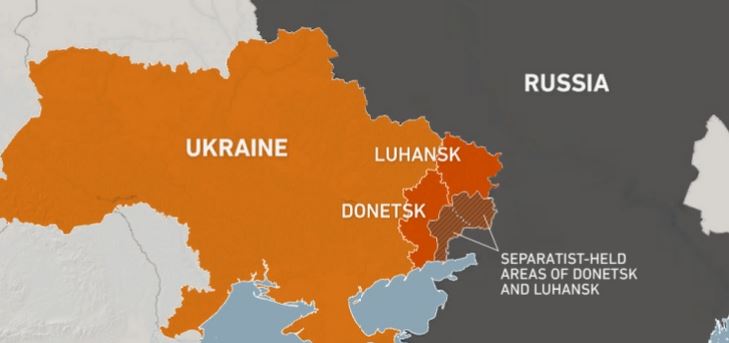
Russia Attacks Ukraine; Stocks Plummet, Oil Surges Above $100
Since 2014, oil prices have wholly broken to around $100 a barrel. Most markets have eventually fallen, and the ruble has reached record lows against the US dollar. This happened after Russian President Vladimir Putin had launched an offensive action in Ukraine.
Stocks plunge, safe-haven assets rise
Major European stock markets have opened 2.5% -4% lower. As a result, the dollar, Swiss Franc, Government bonds, and Japanese Yen have become the safest movements.
Putin has also announced that he will call for the special military operation very soon. Thus, the Ukrainian government has also accused Moscow of launching the offensive.
European leaders say they will freeze assets and close Russian banks off financial markets.
The ruble weakened by almost 7% to the previous 86.98 per dollar, and the Moscow stock market saw a further decline of 10% when it opened after the first suspension. Russia’s central bank then, later on, ordered a ban on the short-selling and even on the over-the-counter markets until further notice.
Equity oil started a decline of 2.6% for Panasian indices (.MIAP00000PUS). The STOXX 600 index in Europe (.STOXX) fell by 2.75%. This has been the lowest since May 2021 and even 10% below the record high in January.
The German DAX (.GDAXI) fell by 3.7%, the sales weight due to the great confidence of Russian energy supplies and the amount sold by its companies in Russia. On the other hand, rising oil prices have helped limit the weight loss of the FTSE 100 (.FTSE) in British commodities. Although it was still 2.3% lower, futures markets are heading for a similar decline.
WTI soars amid shortage fears
The dollar index on the money markets was 0.5%. Assets have seen a sharp rise in volatility during the deepening crisis. It has been around 55% in the last nine days.
Brute oil futures have jumped to the level of 3.5%, reaching the $100 of the barrel for the very first time since 2014 September. In addition, West Texas Intermediate has jumped almost 4.6% to $96.22 a barrel since August 2014.
For safety reasons, this decline also caused AAA-rated government bond yields in Germany to fall by eight basis points to 1,139%, the lowest level in three weeks. The reference 10-year yield in the US also fell by 1.86% from 1.977% to 1.977% and then returned to 1.90%.
Investors are also facing the prospect of the US Federal Reserve’s forthcoming policy to combat rising inflation. The question arising now is whether the conflict will yet give central bankers a reason to postpone the action or whether it can be all caused by further raising the level of energy prices.
While expectations of an aggressive increase of 50 basis points at the March Fed meeting are lower, the future of Fed funds continues to point to at least six rate increases this year. According to Rob Carnell, markets are now more expensive with the risk of something terrible. This, combined with uncertainty, is a terrible environment. No one wants to be put in danger when they drive it.
CFDs are complex instruments and carry a high risk of rapid losses due to margin trading. Consider whether you understand how CFDs work and whether you can afford the risk of losing your money. This article is for educational purposes and is not investment advice.
Author: Andrew Trent
Andrew holds a degree in Data and Statistical Analysis and brings a tech nerd's curiosity to his writing. Off the clock, he's modeling data scenarios for fun, scuba diving, or taking underwater photos. He lives with his two Labradors, Homer and Duff, and his cat, Fibonacci.
Reviewed by: Chris Blakely
Content Editor with over two decades in financial journalism and a degree in Computer Engineering from the Polytechnic of the South Bank. Chris checks every article for factual accuracy and verifies claims before publication.
Last updated: February 24, 2022
Related Reading



Trader Sentiment
Share your outlook and see the results.
Bullish or bearish on EURUSD today?
Bullish or bearish on Bitcoin today?
Trending topics
FOREX HEATMAP
