

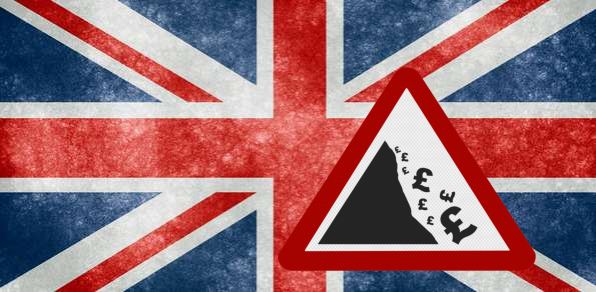
OECD Says Britain Back In Recession
The Bank of England today voted to keep its key interest rate at a 0.50% and to maintain its economic stimulus program amid mixed signals for the British economy. Lately economic data from the UK has been hit or miss and very hard to interpret, making no clear economic picture, current accounts are down, PMI is good, unemployment and housing terrible, personal lending and credit card debt are expanding.
The BoE kept the level of its asset purchasing plan, aimed at boosting lending among banks, at 325 billion pounds (388 billion euros, $514 billion), it said in a statement after a two-day monetary policy meeting. Financial markets took the news in their stride after market expectations had been for no change to the rate or Quantitative Easing (QE), or the central bank’s stimulus program.
Quiet contrary to the US FOMC minutes which showed the US central bank at this time is finished with monetary easing and was not interested in bond buying programs. Speculators must wait until April 18 to interpret the minutes of the meeting and reasons behind the latest decisions amid concerns over the impact on Britain’s fragile economy of the debt crisis in key trading partner the eurozone.
The OECD think-tank last week forecast that Britain was already back in recession, in contrast to the British Chambers of Commerce, which has cited an “encouraging” pick-up in economic activity in the past three months. It is all about your interpretation of the data, if you simply look at reports here and there, things are going well but if you piece them together in a complex puzzle to look at the whole economic health of England one might agree with the OECD.



Recent surveys on construction, manufacturing and services sectors have meanwhile suggested that the economy might return to growth in the first quarter – and thereby avoid recession. The upbeat mood, however, was jolted on Thursday by news of a surprise contraction in manufacturing activity, while most economists expect that the BoE will pump more emergency cash into the economy in the coming months.
A period of sub-trend growth should still result in more QE next month but there is a genuine question mark here and first-quarter GDP, due on 25 April, could be a pivotal indicator. Under QE, the central bank creates new cash that is used to purchase assets such as government and corporate bonds in the hope of boosting lending by retail banks and in turn growing the economy.
The British economy shrank by a worse-than-expected 0.3 percent in the fourth quarter. Another contraction in gross domestic product in the first three months of 2012 would place Britain back in recession, defined as two successive negative quarters.
The economy has also been hampered by elevated oil prices and painful state austerity cuts that are aimed at avoiding a Greek-style debt meltdown.
CFDs are complex instruments and carry a high risk of rapid losses due to margin trading. Consider whether you understand how CFDs work and whether you can afford the risk of losing your money. This article is for educational purposes and is not investment advice.
Author: Andrew Trent
Andrew holds a degree in Data and Statistical Analysis and brings a tech nerd's curiosity to his writing. Off the clock, he's modeling data scenarios for fun, scuba diving, or taking underwater photos. He lives with his two Labradors, Homer and Duff, and his cat, Fibonacci.
Reviewed by: Chris Blakely
Content Editor with over two decades in financial journalism and a degree in Computer Engineering from the Polytechnic of the South Bank. Chris checks every article for factual accuracy and verifies claims before publication.
Last updated: April 5, 2012
Related Reading



Trader Sentiment
Share your outlook and see the results.
Bullish or bearish on EURUSD today?
Bullish or bearish on Bitcoin today?
Trending topics
FOREX HEATMAP
