

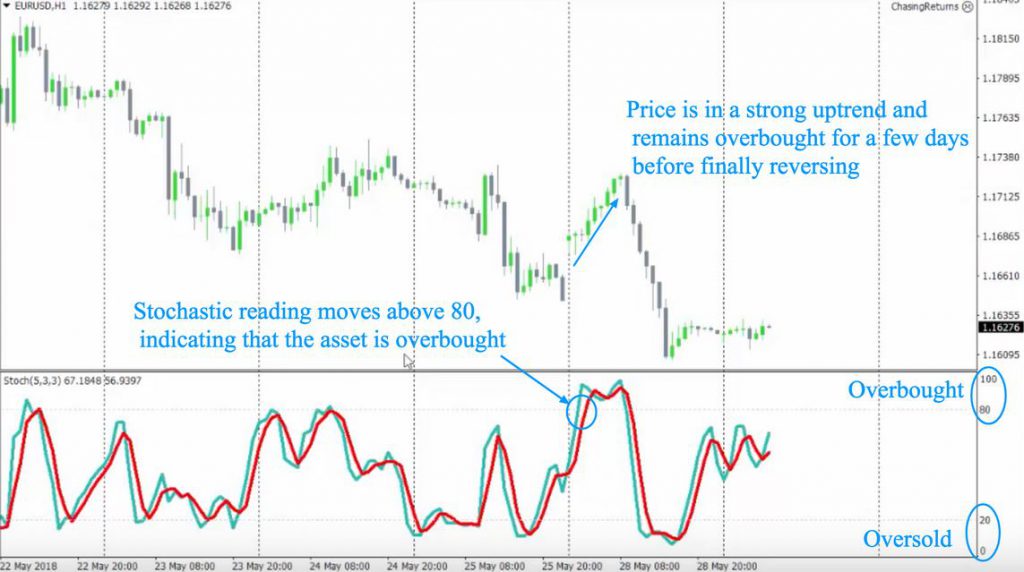
How to use overbought and oversold conditions?
For new traders, the term forex trading means buying in uptrends and selling in downtrends. To become an expert in forex trading, you need to familiarize yourself with other terms, such as overbought and oversold. Trading this way gives you a sense of how much profit you can expect and when you can make it.
Overbought vs oversold levels: What does it mean?
It is the relationship between asset price and price value that describes the overbought and oversold conditions. In addition, it allows the trader to gain knowledge about all the future market conditions and trends in different asset classes. In general, traders can use these levels with shares. But it is also common with few other trading options of commodities or indices.
When a stock is overbought, it means that its price is moving consistently upward. Therefore, traders will trade their assets at a higher price when they meet this condition.
How can you use overbought and oversold levels?
To start using overbought and oversold levels, follow the below steps:
- First of all, create a risk-free trading demo account or the live trading account.
- Now select the market in which you want to trade.
- Use the indicator, i.e., RSI or the stochastic oscillator, to identify overbought and oversold conditions.
- Pick one concept of whether you should go short or long.
- Open up your position, monitor the whole trend, and close it.
Use of indicators for identifying overbought and oversold conditions
For quickly identifying overbought and oversold conditions, traders can use two basic indicators, namely:
- Relative Strength Index (RSI)
- Stochastic Oscillator
RSI is an oscillator that varies from 0 to 100 in range. If the RSI is reading above 70, then it indicates the arrival of overbought conditions! A reading below 30 indicates an oversold situation. Once the RSI reaches 70, most traders prefer to go short. In addition, if the reading is 30, traders will go long. RSI can be used in conjunction with a few other indicators to achieve better results.
The stochastic oscillator is one such momentum oscillator that can help determine whether an asset is overbought or oversold. Additionally, it is scaled from 0-100. Thus, a reading above 80 indicates overbought conditions, while below 20 indicates oversold conditions.
How overbought and oversold conditions help to gain maximum profit?
When a trader uses overbought and oversold conditions, he is simply in a position to profit from any trade. The best way to make maximum profit from the uptrend is to buy when the downtrend reverses. Placing a sell order during the start of a downtrend gives you the best chance of making a profit.
Bottom line
Ultimately, overbought and oversold conditions play an important part in a forex trading session, which can allow you to decide how much profit to make from your first trade. Initially, it was primarily used for trading shares. But now, it is equally good for trading forex, options, and commodities. To identify both levels, you can use technical analysis, price charts, or indicators.
CFDs are complex instruments and carry a high risk of rapid losses due to margin trading. Consider whether you understand how CFDs work and whether you can afford the risk of losing your money. This article is for educational purposes and is not investment advice.
Author: Andrew Trent
Andrew holds a degree in Data and Statistical Analysis and brings a tech nerd's curiosity to his writing. Off the clock, he's modeling data scenarios for fun, scuba diving, or taking underwater photos. He lives with his two Labradors, Homer and Duff, and his cat, Fibonacci.
Reviewed by: Chris Blakely
Content Editor with over two decades in financial journalism and a degree in Computer Engineering from the Polytechnic of the South Bank. Chris checks every article for factual accuracy and verifies claims before publication.
Last updated: August 21, 2021
Related Reading



Trader Sentiment
Share your outlook and see the results.
Bullish or bearish on EURUSD today?
Bullish or bearish on Bitcoin today?
Trending topics
FOREX HEATMAP
