

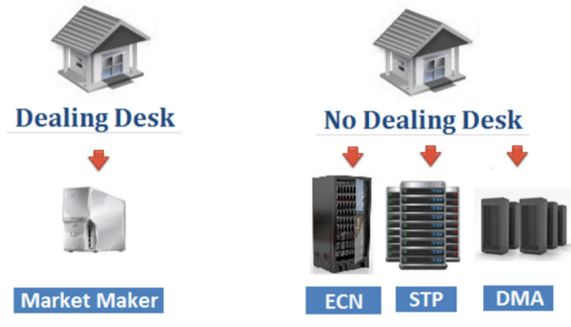
Dealing Desk vs. No Dealing Desk
Before selecting a forex broker, you must first determine what type of forex broker you would like to trade with. The type of execution model your forex broker uses to perform your forex trades in your live account is equally important as the trading platforms, trading tools, and risk management tools they offer.
Forex brokers can be dealing or non-dealing desks, each with advantages and disadvantages. Therefore, let’s begin choosing a forex broker based on your needs.

Dealing Desks (DD)
The term “dealing desk broker” is also used to refer to market makers. Because spreads allow them to make money and provide liquidity to their clients, they usually make a lot of money from spreads by taking the opposite side of their clients’ trade (you!).
By counter trading, they make a market for your buys and sells. A conflict of interest can arise if there are dealing desks that can fill your orders depending on whether or not their opposing position would be profitable for them. However, this is only sometimes the case.
The market maker should fill clients’ orders based on bid/ask quotes while not caring about how the positions perform. Before taking a countertrade or passing it to a liquidity provider, or a large entity that can conveniently buy or sell a financial asset, dealing desk brokers usually search for a matching long or short order from other clients first.
Rather than taking the opposite side of the client’s trade, they earn from the spread, thus minimizing their risks.
No Dealing Desk (NDD)
Market makers and liquidity providers don’t receive orders from no-dealing desk brokers. The main function of these systems is to link two counterparties, either by straight-through processing (STP) or by electronic communication networks (ECNs).
Brokers who offer STP route their clients’ orders through several liquidity providers connected to the interbank market. STP ranks bids and asks according to various factors, such as provider bids and asks before the NDD broker adds a small markup (usually less than a pip) to make a profit. It is for this reason that most STP brokers offer variable spreads.
Furthermore, an ECN broker allows market participants to trade with one another. It could be another retail trader, a hedge fund, an institution, a bank, or a broker.
Additionally, true ECN brokers provide their client’s full visibility into where other market participants buy and sell orders are, allowing them to gauge liquidity and the market’s positioning. Small commissions are usually paid by ECN brokers instead of spreads or markups.
Which type of broker should you trade with?
The choice is yours! Ultimately, it depends on your trading style and preferences whether you choose one or the other. There is a trade-off between tighter spreads and a commission per trade versus wider spreads without a commission.
If you’re considering a broker offering STP or ECN access, read the fine print and read customer reviews.

Bottom line
A Forex broker’s trade structure is crucial to understanding when choosing one. Dealing desk Forex brokers are important to understand. This knowledge can heavily influence your comfort level with a broker. If your broker actively trades against you, it is the biggest problem.
CFDs are complex instruments and carry a high risk of rapid losses due to margin trading. Consider whether you understand how CFDs work and whether you can afford the risk of losing your money. This article is for educational purposes and is not investment advice.
Author: Andrew Trent
Andrew holds a degree in Data and Statistical Analysis and brings a tech nerd's curiosity to his writing. Off the clock, he's modeling data scenarios for fun, scuba diving, or taking underwater photos. He lives with his two Labradors, Homer and Duff, and his cat, Fibonacci.
Reviewed by: Chris Blakely
Content Editor with over two decades in financial journalism and a degree in Computer Engineering from the Polytechnic of the South Bank. Chris checks every article for factual accuracy and verifies claims before publication.
Last updated: December 28, 2022
Related Reading


Trader Sentiment
Share your outlook and see the results.
Bullish or bearish on EURUSD today?
Bullish or bearish on Bitcoin today?
Trending topics
FOREX HEATMAP
