

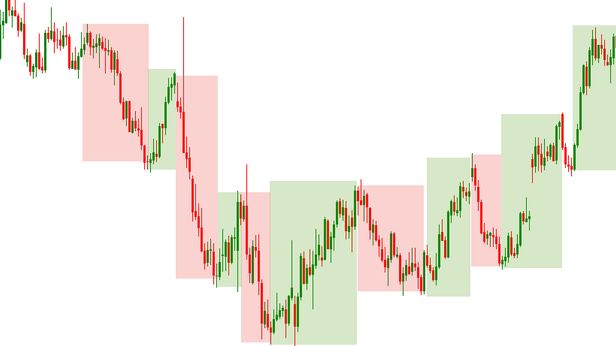
Advantages and Disadvantages Swing Trading Strategies
Forex professional traders are mostly in favor of swing trading. Most positions are held for more than one day, making this a primary way to trade foreign currency.
Swing trading is becoming increasingly popular among forex users, so knowing how it works is essential. We’ll look at the swing trading method in more depth.

What is meant by “swing trading”?
In swing trading, a trader focuses on the higher timeframes and uses technical indicators to predict when to buy or sell an asset. This could go on for a few days or a few weeks.
Swing traders rely on technical analysis to keep track of an asset and predict when a “swing” is about to happen.
Thus, swing traders often don’t care about a currency’s short-term fluctuation when trading. Instead, they bet on the fundamental changes to find which currency is stronger than the other.
What are the pros and cons of swing trading?
Many swing trader’s judge bets by how much they could lose and how much they could win. They look at the chart to find the best points to buy, sell, and place stop-loss orders.
If they’re ready to risk $1 per position to make $3, that’s a tremendous risk-to-reward ratio. But losing $1 for $0.75 is not the right approach.
Technical analysis is usually used for swing trading because they are short-term. But the study could be better if it used fundamental analysis. If a swing trader sees a bullish situation, they want to ensure the asset’s future is bright and improving.
Swing traders look at daily charts a lot to find good entry points. They might also use 1-hour or 15-minute charts to find the exact entry, stop-loss, and take-profit points.

Pros
- When you day trade, you must spend more time than when you swing trade.
- It is the best way to make money in the short run because it takes advantage of price changes.
- Swing traders can only use fundamental analysis, which makes investing more accessible.
Cons
- Weekends and overnight are the worst times for swing trades because the market is more likely to change.
- When the market quickly changes direction, traders could lose a lot of money.
How are day trading and swing trading different?
Day trading, as the name suggests, is when you use technical analysis and advanced tracking tools to make a lot of trades in one day. Day trading aims to make small gains over the day and close all your positions before the market completes.
Swing traders sometimes sell only what they own at the end of every trading day. They could even leave them open for months or even years. Most day traders use technical analysis, but swing traders may also use fundamental analysis.
Bottom line
Swing trading has many benefits, such as making the most of profit potential, needing little time, and giving you more financial freedom. You could lose money over the weekend or overnight, and you won’t be able to take advantage of longer-term price trends.
CFDs are complex instruments and carry a high risk of rapid losses due to margin trading. Consider whether you understand how CFDs work and whether you can afford the risk of losing your money. This article is for educational purposes and is not investment advice.
Author: Andrew Trent
Andrew holds a degree in Data and Statistical Analysis and brings a tech nerd's curiosity to his writing. Off the clock, he's modeling data scenarios for fun, scuba diving, or taking underwater photos. He lives with his two Labradors, Homer and Duff, and his cat, Fibonacci.
Reviewed by: Chris Blakely
Content Editor with over two decades in financial journalism and a degree in Computer Engineering from the Polytechnic of the South Bank. Chris checks every article for factual accuracy and verifies claims before publication.
Last updated: April 18, 2023
Related Reading



Trader Sentiment
Share your outlook and see the results.
Bullish or bearish on EURUSD today?
Bullish or bearish on Bitcoin today?
Trending topics
FOREX HEATMAP
