

Avoiding the Bear Trap in Forex
In a bear trap, the market initially signals a downtrend, then switches and rises again. If you’ve ever found yourself in one of these situations, you know what it’s like. An indication of a possible downturn in the market is called a bear trap.
Despite its name, the bear trap traps are deceptive. After a short pause, the market continues to grow steadily. The impact of a bear trap varies, but one thing is for certain: it is a trap. We will discuss different trading tools technical traders use to identify bear traps shortly.

Why is it called a bear trap?
Strong buying forces characterize a bullish market, and a falling market characterizes a bearish market. Bullish market conditions refer to markets that are rising with strong purchasing forces. The opposite is bearish market conditions, where the market falls mainly due to a selling spree.
Most traders will lean in one direction or another, so traders trade during both bullish and bearish markets. Traders looking for a downtrend will short-sell and exit trades to ensure profits by looking for price patterns that indicate a downtrend.
Bear traps are situations where an uptrend abruptly ends, leading traders to sell short in anticipation of a downtrend. It happens when traders take on a short position when the asset breaks down, hoping to buy back at a lower price, but the trend reverses and shoots up. They produce a trap followed by a sharp rally.
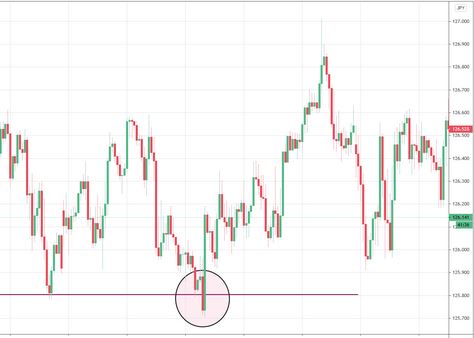
In the chart, you can easily identify a bear trap. A support line is close by. Trade volume is high, indicating a downtrend. For a trap to be confirmed, the trend must closely hold within five candlesticks, and the trend must rapidly cross over the resistance line.
As a second step, you should confirm that the asset has a reasonable price range. An asset with a wide price range offers more trading opportunities.

How does a bear trap work?
A decline in the price of a financial instrument leads traders to believe there is a downtrend. However, the asset’s value remains flat or, worse, rallies, resulting in a loss for you.
Bullish traders might short when an asset’s price drops, while bearish traders might short to buyback when the price drops to a certain level. But a bear trap reverses the trend in the other direction.
Trading in bear trap
For shorting or short selling, traders commonly use bear traps. You can short a stock by selling it high and then buying it when it falls to make a profit. A bear trap trader can short a stock in a few ways, including borrowing it from the broker on margin.
You sell the stock at current prices when you expect the market to fall to buy it back at a lower price to return it to the broker.
Recapitulation
- Markets of all types can fall victim to bear traps, which are false trend reversals.
- The short-sell strategy deceives traders who open short positions that ultimately lose value.
- A bear trap is common in the stock market, bond market, futures market, and currency market.
- Short traders will be more at risk if they misinterpret the trend during a bear trap than bullish traders.
- Technical charts can help you identify bear traps in advance
- A divergence from a bear trend can indicate a trap if price action signals a possible end to the bear trend
- Place a stop-loss to minimize your losses
- Bull traps also exist in the market but work in the opposite direction.
Bottom line
If you’re inexperienced, you might need help identifying a bear trap on a chart in advance. You will inevitably encounter a bear trap at some point in your trading career. But with practice and the assistance of market indicators, you will learn how to spot it. Apply a stop-loss if you encounter a sudden downtrend and are unsure what to do. This will prevent you from losing more than you intended.
CFDs are complex instruments and carry a high risk of rapid losses due to margin trading. Consider whether you understand how CFDs work and whether you can afford the risk of losing your money. This article is for educational purposes and is not investment advice.
Author: Andrew Trent
Andrew holds a degree in Data and Statistical Analysis and brings a tech nerd's curiosity to his writing. Off the clock, he's modeling data scenarios for fun, scuba diving, or taking underwater photos. He lives with his two Labradors, Homer and Duff, and his cat, Fibonacci.
Reviewed by: Chris Blakely
Content Editor with over two decades in financial journalism and a degree in Computer Engineering from the Polytechnic of the South Bank. Chris checks every article for factual accuracy and verifies claims before publication.
Last updated: February 2, 2023
Related Reading

Trader Sentiment
Share your outlook and see the results.
Bullish or bearish on EURUSD today?
Bullish or bearish on Bitcoin today?
Trending topics
FOREX HEATMAP
