

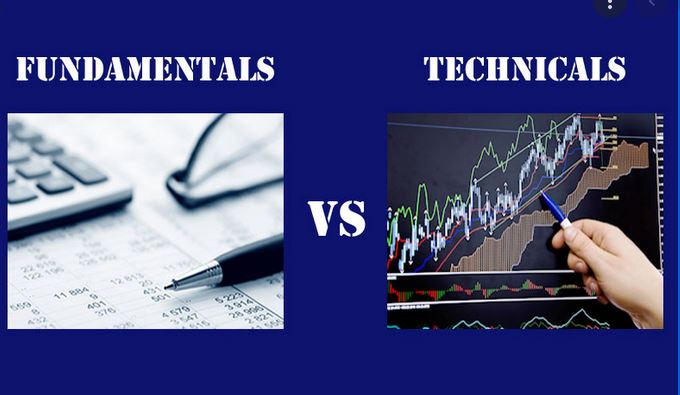
Technical vs. Fundamentals: What is the best?
Fundamental and technical analysis are the two major bodies of trading literature. With these two bodies, traders can make informed investment decisions to gain profitable results. Thus, it enables the investor to decide whether to hold, buy or sell any asset in a regulated market.
To help you differentiate between technical and fundamental analysis, we have a quick guide for you and a comparison chart for a better understanding.
What is meant by technical analysis?
Technical analysis is generally based on the volume data or asset’s price. Its main objective is not just to predict the coming future but also to identify certain similar scenarios.
Price action is utilized as the indication related to how the market participants were acting in the past and how they will act in the future.
Technical experts can use trends, chart patterns, price, volume behavior, and support & resistance levels to identify upcoming trading opportunities.

What is fundamental analysis all about?
If we talk about fundamental analysis, it is a method used for the company’s evaluation and figuring out the intrinsic value of its stock. Companies are generally valued as if they were completely unlisted in which no market prices are involved.
Selling and buying decisions are made if the stock is traded at a premium or discount value. Thus, a trader can also apply this analysis to other markets such as commodities and currencies. In this situation, any factor affecting the asset value is yet considered.
Which tools are used for technical and fundamental analysis?
In the fundamental analysis, different tools are used by the analysts, which include economy, competitor, and the market in which they are operating.
For stocks, an important source of data is a company’s financial statements, which include cash flow statements, income statements, or balance sheets.
On the contrary, different price charts are used in technical analysis, including bar charts, line charts, or candlestick charts. Based on the price charts, tools can somehow vary widely.

Comparison between technical vs. fundamental analysis
| Basis for comparison | Fundamental analysis | Technical analysis |
| Best for | Long term investments | Short term investments |
| Performs | Investing | Trading |
| Main function | Identifying the intrinsic stock’s value | Identify when is the best time to exit or enter a market |
| Focus on | Past and present data | Only past data |
| Forms of data | News events, economic reports, and industry statistics | Charts |
| Trader’s type | Long term position trader | Short term trader and swing trader |
| Decisions | Decisions are made through the information available and the latest statistics evaluated. | Decisions are made through the latest market trends and upcoming prices of stock. |
Final thoughts
To end with the discussion, for investing in an unlisted company, choosing fundamental analysis is something that can work best for you. You can learn a lot from the trading history of fundamentals for the listed stocks. In short, in the fundamental analysis, any investor can buy a stock when the stock price is a bit lesser than the intrinsic stock’s value. But in technical analysis, any trader can buy stocks when they know that they can sell them at a higher price.
CFDs are complex instruments and carry a high risk of rapid losses due to margin trading. Consider whether you understand how CFDs work and whether you can afford the risk of losing your money. This article is for educational purposes and is not investment advice.
Author: Andrew Trent
Andrew holds a degree in Data and Statistical Analysis and brings a tech nerd's curiosity to his writing. Off the clock, he's modeling data scenarios for fun, scuba diving, or taking underwater photos. He lives with his two Labradors, Homer and Duff, and his cat, Fibonacci.
Reviewed by: Chris Blakely
Content Editor with over two decades in financial journalism and a degree in Computer Engineering from the Polytechnic of the South Bank. Chris checks every article for factual accuracy and verifies claims before publication.
Last updated: May 11, 2022
Related Reading

Trader Sentiment
Share your outlook and see the results.
Bullish or bearish on EURUSD today?
Bullish or bearish on Bitcoin today?
Trending topics
FOREX HEATMAP
