

How to gauge risk sentiment in the Forex market?
A risk-on/risk-off strategy, also known as RoRo, is likely to be one of the most applicable terms to the financial markets, regardless of what type of asset one is trading. Traders can leverage this information to their advantage based on the underlying sentiment and thus take appropriate positions based on their interpretation.
What is market sentiment?
In most cases, trading is determined by sentiment or how investors feel. For example, optimistic people usually take on additional risks. This scenario is called ‘risk-on sentiment’ because investors prefer to purchase riskier, higher-yielding investments over low-yielding ones. A risk-on sentiment can be characterized, for example, by the equity markets rising above the low-yielding, safer assets, such as US treasuries falling.
Inversely, an investor who begins to be conscious of the market will scale back their bullish bets and instead opt for safe, low-yielding assets like US Treasuries while selling off their stake in risky assets like stock markets.
Applying risk-on-risk-off to the Forex markets
After gaining an understanding of market sentiment, let’s examine how RoRo relates to currency markets. The following table summarizes the various categories that distinguish each major G8 currency (AUD, USD, CHF, GBP, EUR, JPY, NZD, CAD) from a ‘haven’ to ‘risky currency.’
Safe haven currencies
- USD
- JPY
- CHF
Risk currencies
- AUD
- NZD
- CAD
Risk-on sentiments:
The risk-on sentiment is stronger among in-demand currencies like the AUD, NZD, CAD
Risk-off sentiments:
USD, JPY, and CHF tend to outperform the riskier currencies.
Note: A strong sentiment leads to the US Dollar’s strong rise. However, the Dollar’s performance is mostly neutral.
How to determine market sentiment before starting your trading day?
- During the European/US session, traders start with the Asian markets and look at how the US markets closed the previous day.
- It’s crucial not to trade blindly based on sentiment but to conduct individual assessments of the currency pairs before taking a position.
- The market’s sentiment can change fairly quickly within a day, which demonstrates why it’s important to perform a thorough fundamental and technical analysis of currency pairs.
- There is also a significant correlation between gold and risk sentiment. Increasing geopolitical tensions and market uncertainty tend to boost gold prices.
- An important note about EURUSD: When the German DAX falls along with its peers, the Euro tends to rise against the Dollar.
Risk sentiment examples
Risk-off chart

Risk-off sentiment
• Equity prices fall (Nikkie225, Dow Jones, S&P500)
• In terms of risk assets, JPY outperforms AUD
• AUD outperforms EUR risk asset
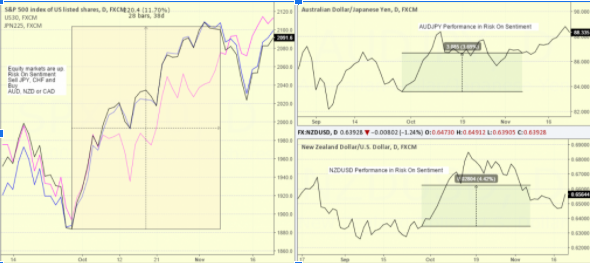
Risk-on chart

Risk-on sentiment
• Equities are on the rise
• The JPY is weakening as risk currencies rise
• USD outperformed by NZD, AUD outperformed JPY.
Bottom line
Knowing market sentiment is useful for traders because it helps them to better position themselves and selects the currency pairs that tend to be the most profitable. In the Forex market, market sentiment is nothing more than inter-market analysis. With the right training, traders will be able to forecast which way the wind is blowing and thus will be able to make money no matter what happens in the markets.
CFDs are complex instruments and carry a high risk of rapid losses due to margin trading. Consider whether you understand how CFDs work and whether you can afford the risk of losing your money. This article is for educational purposes and is not investment advice.
Author: Andrew Trent
Andrew holds a degree in Data and Statistical Analysis and brings a tech nerd's curiosity to his writing. Off the clock, he's modeling data scenarios for fun, scuba diving, or taking underwater photos. He lives with his two Labradors, Homer and Duff, and his cat, Fibonacci.
Reviewed by: Chris Blakely
Content Editor with over two decades in financial journalism and a degree in Computer Engineering from the Polytechnic of the South Bank. Chris checks every article for factual accuracy and verifies claims before publication.
Last updated: October 20, 2021
Related Reading



Trader Sentiment
Share your outlook and see the results.
Bullish or bearish on EURUSD today?
Bullish or bearish on Bitcoin today?
Trending topics
FOREX HEATMAP
