

How to Trade Triangle Formation Correctly?
The trading business is unpredictable. Often, we feel we have made the right decision, but somehow we still suffer a significant loss. This is not because of patterns but some mistakes that traders make while dealing with the patterns. In this article, we will discuss triangle formation and how the triangle formation does not work. We will try to understand the reasons for the false trade emergence.
The triangle formation
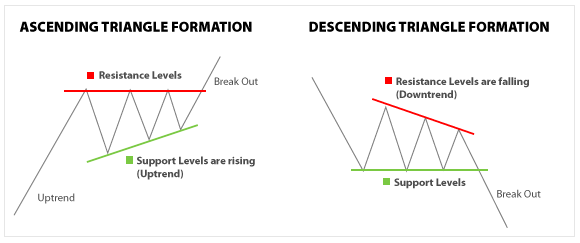
The triangle formation is ascending, descending and symmetrical, which is quite helpful for traders because it can easily indicate a breakdown direction. Triangles form when a price trend tends to squeeze. It means that the market participants are no longer interested in carrying out further. Such a scenario gives us an opportunity to ride on a fresh trend with low risk higher rewards. But it is still now easy to trade them. Let us look at the types of triangles.
Ascending triangles
First, we have the ascending triangles. In this kind of triangle, if the trend line has an upward slope and connects the valleys, it will be ascending. The local vertices touch the upper lines many times, and it is compulsory to look for the concerned price.
The price must cross its area while bouncing up and down from the upper boundary to the bottom. In an ascending triangle, the volume is decreasing as a rule. It can be a low few days before the triangle breakdown. But sometimes, the situation can also change.
For trading the ascending triangle pattern, wait for a breakout to occur. Do not enter right after the breakout. Rather, wait for the retest of broken structure and then enter the long position.
Descending triangles
The next is the descending triangle. The descending triangle is a bearish chart pattern created by connecting a trend line series of lower highs while the horizontal line connects the series of lows. If you see a downward triangle breaking down, then you know it is a descending triangle. You can trade the descending triangle patterns with short selling positions.
For trading the pattern, wait for a breakout to occur. Do not enter right after the breakout. Rather, wait for the retest of broken structure and then enter the short position.
Symmetrical triangles
Lastly, we have a symmetrical triangle. This kind of triangle pattern represents a formation when the compilation of the price action happens before the price creates either a breakdown or a breakout. Ironically, symmetrical triangles unite the worst features of ascending and descending triangles. Failed studies happen in almost half of the cases from all graphic models, meaning nearly half of all transactions.
Bottom line
The main issue with triangles is that they do not work in the initial breakdown direction; if such is the case, it would be best for a trader to open a new order because, ultimately, the main aim in trading is simply making more money.
CFDs are complex instruments and carry a high risk of rapid losses due to margin trading. Consider whether you understand how CFDs work and whether you can afford the risk of losing your money. This article is for educational purposes and is not investment advice.
Author: Andrew Trent
Andrew holds a degree in Data and Statistical Analysis and brings a tech nerd's curiosity to his writing. Off the clock, he's modeling data scenarios for fun, scuba diving, or taking underwater photos. He lives with his two Labradors, Homer and Duff, and his cat, Fibonacci.
Reviewed by: Chris Blakely
Content Editor with over two decades in financial journalism and a degree in Computer Engineering from the Polytechnic of the South Bank. Chris checks every article for factual accuracy and verifies claims before publication.
Last updated: July 24, 2021
Related Reading


Trader Sentiment
Share your outlook and see the results.
Bullish or bearish on EURUSD today?
Bullish or bearish on Bitcoin today?
Trending topics
FOREX HEATMAP
